
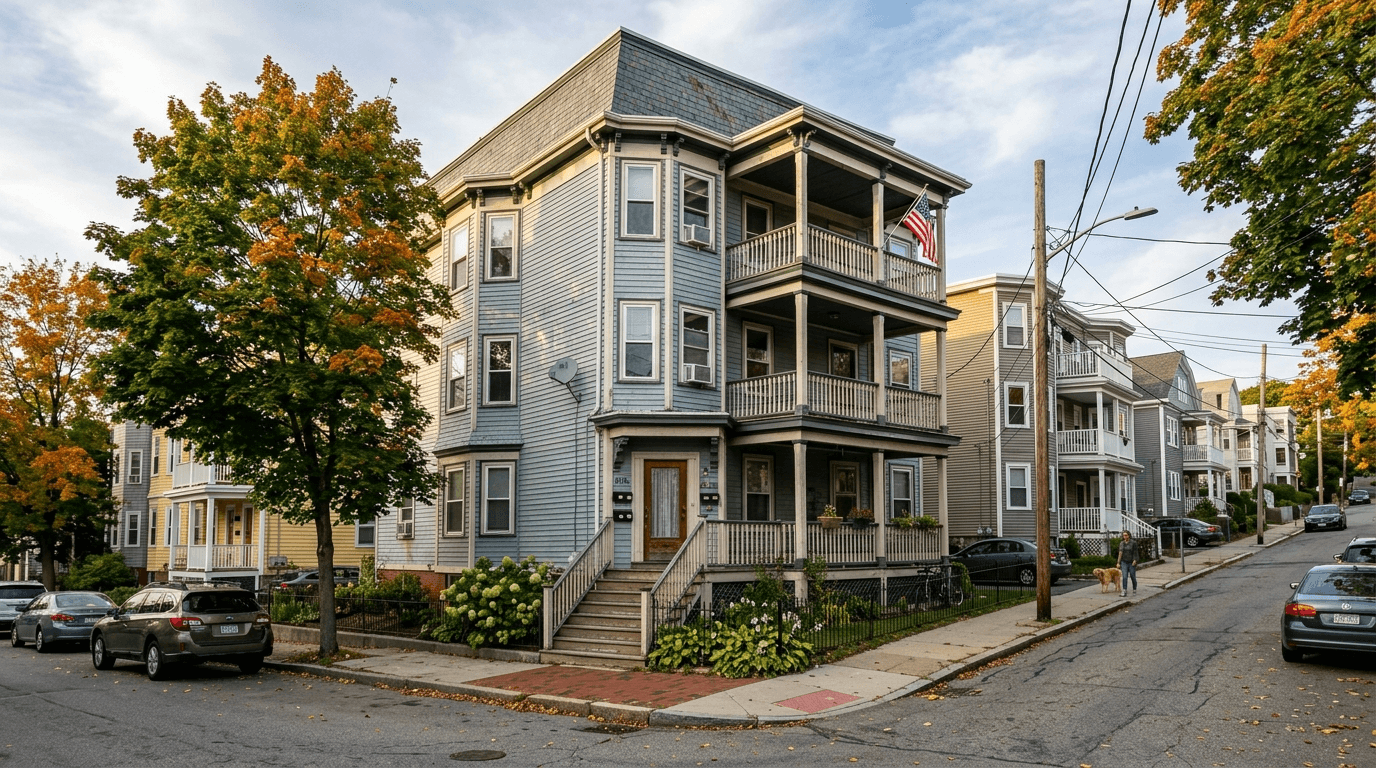
Update, October 2026: On July 17, 2026, the Boston Planning Department released draft zoning for Hyde Park, Roslindale and West Roxbury. It would allow a detached ADU in a rear yard and, per the draft's notes, drop the ADU owner-occupancy requirement. It is still a draft: comments received by October 31 will be published in mid-November, a second draft is expected, and the Zoning Commission has to adopt it. Until then, the rules below apply (Boston Planning Department, read Oct. 31, 2026).
Key Takeaways
•The short answer: Inside Boston, the by-right path for an accessory dwelling unit (ADU), a small extra apartment on the same lot, is built for people who live on the lot. By-right means approval is automatic if you follow the rules. Baystate Group Builders notes that Boston is excluded from the state's ADU framework, including its ban on owner-occupancy rules.
•The state rule: Across Massachusetts outside Boston, towns cannot require an owner to live on-site, per the Real Estate Bar Association. An absentee landlord can build there by right.
•Boston's rule: According to Boston.gov's ADU guidance, owner-occupants of 1-3 family homes can add an ADU as of right. Interior conversions are the main option.
•The bottom line: If you won't live there, compare Quincy, Milton, and other towns, but still check local rules. If you will live there, Boston can work, usually as an interior conversion.
Why Does Boston Play by Different ADU Rules Than the State?
Many buyers assume the statewide ADU law treats every landlord the same. It does not. Boston is its own game.
An ADU could be a basement unit, an attic apartment, or a backyard cottage. If your plan follows the rules, a by-right project must be approved. You don't need a special hearing or a board vote.
According to Baystate Group Builders, Governor Healey signed the Affordable Homes Act on August 6, 2024, and "Boston is explicitly excluded" from its ADU framework. For the state's official guidance, see Mass.gov/ADU.
CommonWealth Beacon's August reporting notes that a homeowner across the Neponset River in Milton or Quincy follows different ADU rules than one in Boston. An absentee investor may find a by-right path on a Quincy single-family that a similar Roslindale property doesn't offer. Local permitting and paperwork still apply in those towns.
The gap may widen. CommonWealth Beacon reports that a Senate bill passed in July would allow two-family homes by right on any residential lot, in every community except Boston. If it becomes law, the case for building outside Boston as a non-occupant grows stronger.
So the key question is: Will I live on the property?
What Can an Owner-Occupant Build by Right Inside Boston?
According to Boston.gov's ADU guidance, owner-occupants of 1-3 family homes can add an ADU as of right. Confirm the details for your lot with the Boston Planning Department.
The most realistic option is an interior conversion, which turns existing space, such as a basement or attic, into a legal apartment.
One caution: Boston.gov's ADU guidance says detached ADUs can be built without special approval only in the PLAN: Mattapan area, and elsewhere they may need Zoning Board of Appeal approval (Boston.gov, read Oct. 31, 2026). Don't assume you can build a backyard cottage anywhere in Boston.
What Are the Main Pros for Boston Owner-Occupants?
Lower cost is the biggest advantage.
•Interior conversions cost $75,000 to $100,000, according to the city's ADU FAQ as summarized by ADUZoning.org. This is the figure for Boston's main path.
•Full new builds cost $150,000–$400,000+, according to CORE Remodeling.
•Detached units average $173,734 in New England, according to Baystate.
Conversions cost less because the foundation, roof, and walls already exist. That gap can decide whether a project makes financial sense.
Financing help may be available. According to Boston.gov, the Boston Home Center offers ADU financing support to owner-occupants. Check current terms and income limits before you plan around it.
The lifestyle benefit is real. You can house an aging parent, give an adult child private space, or offset your mortgage with rent.
What Are the Main Cons for Boston Owner-Occupants?
You must keep living there. Boston's by-right path is built around owner-occupancy.
A space that "feels usable" is not always a legal apartment. Before you budget, ask Inspectional Services which safety items your unit needs. One example is egress, which means a safe way out in a fire.
Volume is growing but still small. Boston.gov reports 51 ADUs permitted in 2025 as of September, up from 34 in all of 2024.
Boston ADU Permits: 2024 vs. 2025 to Date
Boston ADU permits increased from the full year 2024 count to the partial-year 2025 count reported as of September.
| Series | Label | Value |
|---|---|---|
| ADUs permitted in Boston | 2024 | 34 |
| ADUs permitted in Boston | 2025 as of September | 51 |
For a city Boston's size, that means fewer contractors who know the process and fewer finished examples to learn from. Don't build your budget around a quick approval.
What Wall Does an Absentee Investor Hit in Boston?
Inside Boston, the path for non-occupants is less clear. Outside the owner-occupied route, you may need zoning relief (special permission to break a zoning rule), which can mean hearings and delays. Delays raise your carrying costs, the monthly costs of holding the property, such as mortgage, taxes, and insurance. Confirm with the Boston Planning Department before you make an offer.
Across Massachusetts towns under the state framework, the Real Estate Bar Association's April 2026 update says "neither the primary residence nor the ADU must be owner-occupied." The state's by-right size cap is 900 square feet, or half the main home's floor area if that is smaller.
Massachusetts ADU Size Rules Under the Affordable Homes Act
Statewide by-right ADU size limits using the primary state source.
| Category | ADU size rule |
|---|---|
| Maximum ADU size allowed by right | 900 square feet |
| Alternate size limit | no larger than half the gross floor area of the principal dwelling |
On small homes, that cap can leave a very small unit. Start your deal math with the smaller of the two limits so you don't overestimate rent or bedroom count.
Watch the variance rules. To get a variance, owners have had to show "substantial hardship." CommonWealth Beacon reports that the fiscal 2027 budget changed that to "practical difficulty." Boston has its own zoning law, so ask the Planning Department whether the change applies before you rely on it.
How Does Boston Compare With the State Framework?
The table below sets Boston's owner-occupant path beside the state rules that cover towns like Quincy and Milton. It draws on Boston.gov's ADU guidance, the Real Estate Bar Association, and the state's approvals release.
Boston versus State ADU Framework
Compares owner-occupancy requirements, typical ADU options, and non-occupant permitting paths inside Boston versus Massachusetts communities under the statewide ADU framework discussed for 2025-2026.
| Category | Inside Boston | Outside Boston (state framework) |
|---|---|---|
| Owner-occupancy | By-right path is for owner-occupants | Cannot be required |
| Typical option | Interior conversion | Up to 900 sq ft or half the floor area |
| Non-occupant path | Expect zoning relief; confirm with the city | By right, subject to local permitting |
Statewide, Massachusetts has approved 2,084 ADUs since the start of 2025, including 854 in the first six months of 2026.
Massachusetts ADU Momentum Since Statewide Legalization
Headline statewide ADU approval counts from the first half of 2026 and cumulative approvals since the start of 2025.
Massachusetts ADU approvals
Approved ADUs during the first six months of 2026854
Statewide total approved ADUs since the start of 20252084
For a non-occupant, that means the state path is well used, not just a rule on paper. If your plan depends on Airbnb-style income, confirm the town's short-term rental rules before you write an offer.
What Are the Strongest Arguments Against This Reading?
"House-hackers are investors too."
True. Someone who buys a three-family, lives in one unit, and adds an ADU is investing, and that fits Boston's owner-occupant model. But owner-occupancy only gets you through zoning. Whether a house-hack makes money depends on local rents, your loan rate, and build cost.
"By-right hasn't meant easy outside Boston either."
Also true, because local rules and paperwork can still slow projects. Even so, CommonWealth Beacon reports just over 1,200 permits in the law's first year.
Boston's question comes earlier: whether a non-occupant qualifies at all. The state's approval counts don't say how many went to absentee owners, so check each town case by case.
So Who Actually Wins Boston's ADU Play?
Winner: the owner-occupant. It is a narrow, lightly used path, but it is the clearest by-right route inside Boston.
If you won't live on-site, compare Quincy, Milton, and other towns covered by the state framework, and check each town's local rules. Revisit Boston if the variance change applies there.
If you will live on-site in Boston:
1. Confirm the home is a 1-3 family.
2. Check zoning with the Boston Planning Department.
3. Start with the city's estimated interior-conversion range of $75,000 to $100,000 (per Boston's ADU FAQ, via ADUZoning.org).
4. Ask the Boston Home Center about ADU financing.
5. Apply through Inspectional Services (ISD) for permits.
Watch two policy tracks: any zoning updates from the Boston Planning Department for your neighborhood, and whether the Senate duplex provision becomes law. Keep your permits on file to prove the unit is legal when you sell or refinance.
As Jesse Kanson-Benanav told CommonWealth Beacon, "we are a city in a state… We just have this unique element."
If you're set on Boston, the clearest route is to buy a home you will live in, add the unit legally, and stay.
Want to test a specific Boston property? Send the address before you make an offer. We'll review the zoning, the likely ADU path, and whether the numbers work.